An AI assistant can help us draft a document, organise information, find a bug in code or prepare a summary. If the result is useful and the work takes less time, we have gained something. But saved time does not decide on its own what happens next.
Productivity is an opportunity, not a strategy. Employees need to learn how to use the tools; managers need to decide how to turn the time they free up into value. A company needs to do both.
If you work for a company, start with its tools
If you are an employee, do not put work documents, emails or data into a free personal account. Ask which tools your company approves and what you can use them for. It may already provide a managed service that has not yet been made clear to everyone.
The difference is not just who pays for the subscription. An organisation-managed account may have different terms, settings and controls from a personal one. Before sharing confidential information, check that the tool is approved for that kind of data. If you are unsure which one to use, ask your manager or IT contact.
Then ask for training. A chatbot link is not training, just as handing someone a spreadsheet does not teach them how to use it. People need time to try real tasks, understand a model’s limits and learn how to check its work.
Go beyond question and answer
Asking for an answer is a start. The next step is building a reliable way to work: a prompt template, a sequence of checks or an assistant configured for a recurring task.
Instead of asking “summarise this meeting” every time, for example, we can define a format that separates decisions, actions, owners, deadlines and open questions. Or we can prepare a process that compares a request with a policy and flags points to check, without approving or rejecting it on our behalf.
A useful workflow says what to provide, what result to expect and how to check it. Try it on real but non-sensitive cases, compare the output with the work of an experienced colleague and revise it when it fails. If it works, document it and share it with the team.
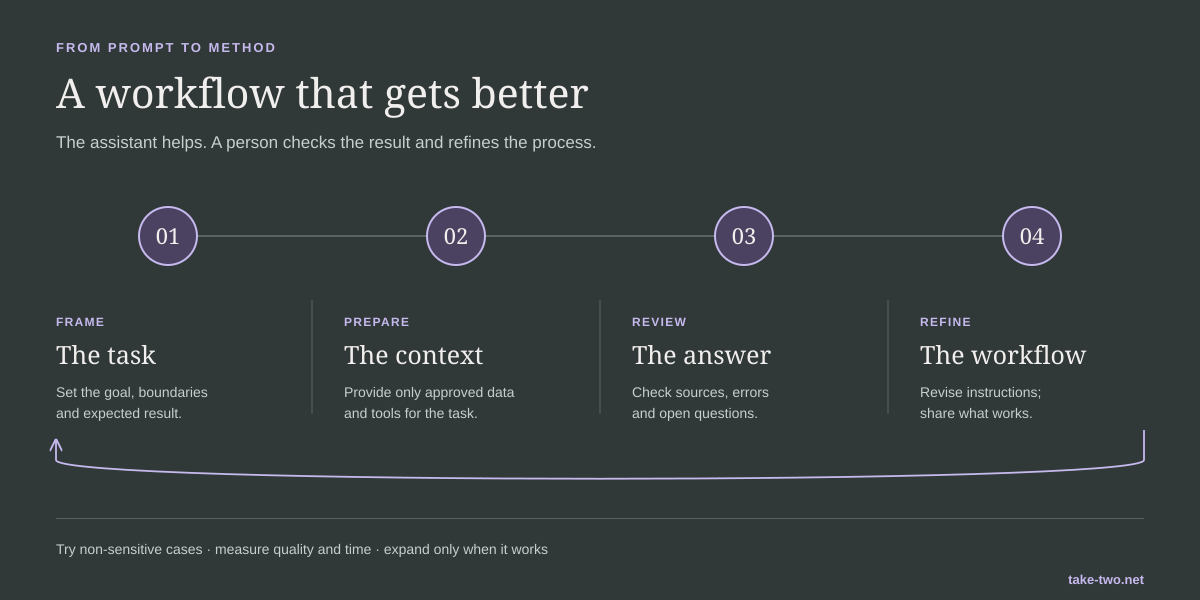
The technology can also complete several steps and use tools, not just answer in a chat. That makes it even more important to understand what we are asking it to do. First learn which tools are available, what permissions they have and where their limits are. Then choose a bounded task and measure the result. A virtual assistant is no shortcut for understanding the work.
Managers: providing the tool is only the first step
A company can activate licences for everyone and still see little change. Without use cases, time to experiment, training and clear rules, people may carry on as before or use the tools without knowing what information is appropriate to share.
Higher productivity creates a choice: where should the time we free up go? There is no single answer for every business, but the choice should be explicit and shared with employees.
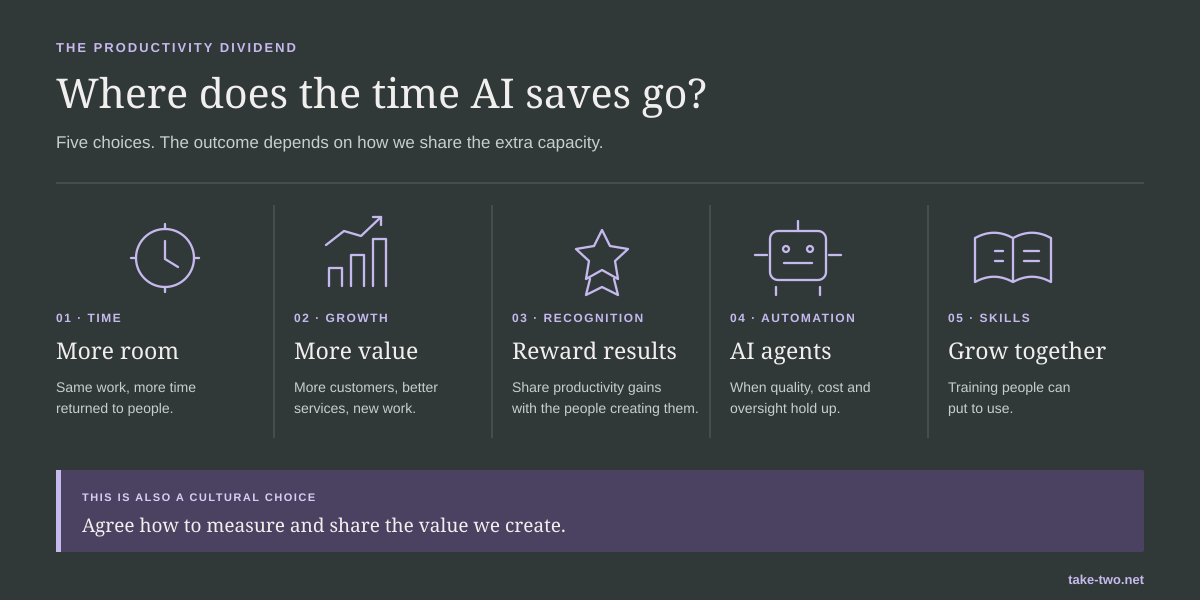
We can do the same work in less time and give people more room to recover, without automatically turning every saved minute into a new target. We can use the capacity we free up to serve more customers, improve a service or deliver more work. If results grow, we can recognise people’s contribution with productivity bonuses.
We can also automate parts of a process with AI agents. That is a real option, but the comparison needs to include quality, cost, oversight, error handling and continuity. Replacing a person with an agent while maintaining the same service level takes capable tools and people who can configure them, monitor them and step in when something goes wrong. A projected saving alone does not show that the change makes sense.
Or we can invest some of the time we gain in people: training, new skills, work we could not previously take on and better processes. This needs clear goals and real chances to apply what people learn; a course without room to practise is unlikely to change the work.
These options can coexist. A team can reduce repetitive tasks, spend more time with customers and learn to manage the agents that support the process. Before asking for more output, though, agree how to measure it and how to share the value the team creates.
Investing in people is a growth decision
AI is an opportunity, and change is already under way. Standing still can leave a business behind; overestimating what the tools can do can mean cutting the expertise and experience needed to get good results in the first place.
The answer is neither to hand everything to technology nor to ignore it. We can pair people with assistants, train the people who use them, automate suitable work and put the capacity we free up towards creating more value. The business can grow, along with the value of the skills of the people who help it do so.
Everything is moving quickly. Can we make the right decisions, and revisit them as we learn?