Artificial intelligence is already part of school life, even though we do not yet know what it will become. Students can use it for schoolwork, teachers have to rethink the assignments they set, and parents have to help young people navigate a change that affects them too. We can pretend this technology does not exist, or learn what it can do and use it with care.
There is no definitive manual that applies to every class, subject and family. But we can start by getting to know these tools, understanding where they fail and finding ways to use them without handing over our judgement. That is the thread connecting students, teachers and parents.
Students: learning to learn
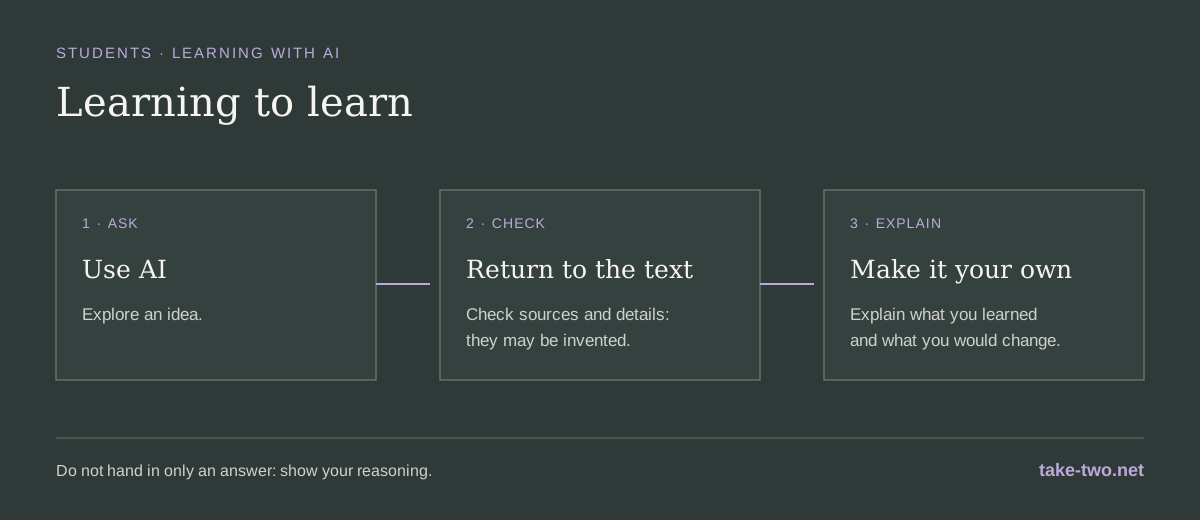
You are not fooling anyone: people can tell when an assignment has been produced entirely by AI. Pasting an agent’s answer may look like a shortcut, but it does not really fool the people who know your work—and, above all, it does not help you learn. The point is not to have the tool do your homework or to avoid every difficult part. The point is to learn how to use it: understand what it can do, ask a clear question, judge the answer and improve it.
That does not mean you cannot ask for help. If a passage is difficult, AI can try to explain it in simpler words or give an example. If you do not know how to begin, it can help you organise your ideas. If you have a draft, it can point out places that are unclear. But understanding, checking and deciding what to hand in remain your responsibility. An answer can sound fluent and convincing while still being wrong.
Not every teacher has had a chance to explore what AI can do or how to teach students to use it. It is new for everyone, even if some students have already started experimenting on their own. We will not close this gap by pretending the tools do not exist or simply banning them.
Students can use the time and spaces they have with one another to compare attempts, see what works and share what they learn. They can also involve their teachers—not to take over the teacher’s role, but to find a way of exploring a technology that is new to everyone. Learning to use AI thoughtfully can become shared work: students bring curiosity and practical experience, while teachers help give the exploration structure and purpose.
Imagine that you have to write a response to a short story. You could ask AI to pose questions that help you identify its themes, or to explain a passage you do not understand. If you ask it for a summary, compare that summary with the story: did it leave out an important detail? Did it attribute an intention to a character that the author never states? That check is part of learning, not an administrative step to do afterwards.
A useful student prompt does not ask AI to hand over a finished assignment. It treats the tool as a tutor and leaves the work of understanding, checking and writing to the student:
Prompt for students
Help me work through this assignment without writing the answer for me: [paste the assignment]. First ask what I already understand and where I am stuck. Then guide me one step at a time with questions and hints. If we use a text, distinguish ideas that actually appear in the source from your own interpretations. At the end, ask me to explain the reasoning in my own words and help me check that my answer addresses the assignment.
The same request can be set out in XML. The tags make the goal and limits clearer; they do not make the answer automatically reliable:
<task role="student-tutor">
  <context>
    I am a student working on a school assignment.
    I want to understand the topic and produce my own work,
    not submit an answer generated entirely by AI.
  </context>
  <materials>
    <assignment>[Paste the teacher's complete instructions]</assignment>
    <source>[Paste or describe the assigned reading, if relevant]</source>
    <my-attempt>[Describe what you have tried, if you have started]</my-attempt>
  </materials>
  <goal>
    Help me understand the assignment, identify difficult steps
    and make progress without doing the work for me.
  </goal>
  <method>
    First explain in simple words what the assignment asks,
    then ask what I already understand and where I am stuck.
    If important information is missing, ask me before suggesting
    a solution. Work one step at a time: ask questions, offer hints
    and explain difficult ideas with examples.
    If I provide a source, separate information stated in it
    from interpretation and point me to the passage to check.
    If I share a draft, identify unclear parts and suggest questions
    that could help me improve it without rewriting the whole draft.
  </method>
  <limits>
    Do not invent quotations, page numbers, facts or missing details.
    If you cannot verify a claim, say so clearly.
    Do not write a final answer ready to submit.
    Do not pretend to have read a source I have not provided.
  </limits>
  <expected-result>
    Keep this conversational. At the end, help me list the ideas
    I understand, the points I still need to check and the steps
    I completed myself.
  </expected-result>
  <final-check>
    Ask me to explain the reasoning in my own words.
    Help me check that the work addresses the assignment,
    that claims are supported by sources and that I can explain
    the parts I plan to submit.
  </final-check>
</task>
For an assignment based on a particular reading, a more focused prompt can sit beside the text. The student provides the source and asks AI to help analyse it, with each observation tied back to evidence:
<task role="critical-reading-of-a-text">
  <assignment>[Paste the teacher's instructions]</assignment>
  <source-text>
    [Paste the assigned text or identify the excerpt supplied in class]
  </source-text>
  <goal>
    Help me understand the text and prepare my own analysis.
    Do not write a finished submission for me.
  </goal>
  <steps>
    1. Ask what I already understand and which part is difficult.
    2. Summarise the main ideas using only information in the text.
    3. For each observation, point to the sentence or passage that supports it.
    4. Flag ambiguity and distinguish details in the text from interpretation.
    5. Suggest questions that help me develop my own critical reading.
  </steps>
  <comparison>
    If I ask for a summary, remind me it may omit details or contain errors.
    Help me compare it with the source and identify any information
    that was added but does not appear in the text.
  </comparison>
  <limits>
    Do not invent quotations, page numbers, characters or authorial intent.
    If a claim is unsupported by the text, say so.
    If the excerpt is incomplete or unreadable, ask me for clarification.
  </limits>
  <expected-result>
    Return a working outline with ideas to check, source references
    and open questions. Leave the writing of the analysis to me,
    then ask me to explain my conclusions in my own words.
  </expected-result>
</task>
Teachers: raise the level of assignments!
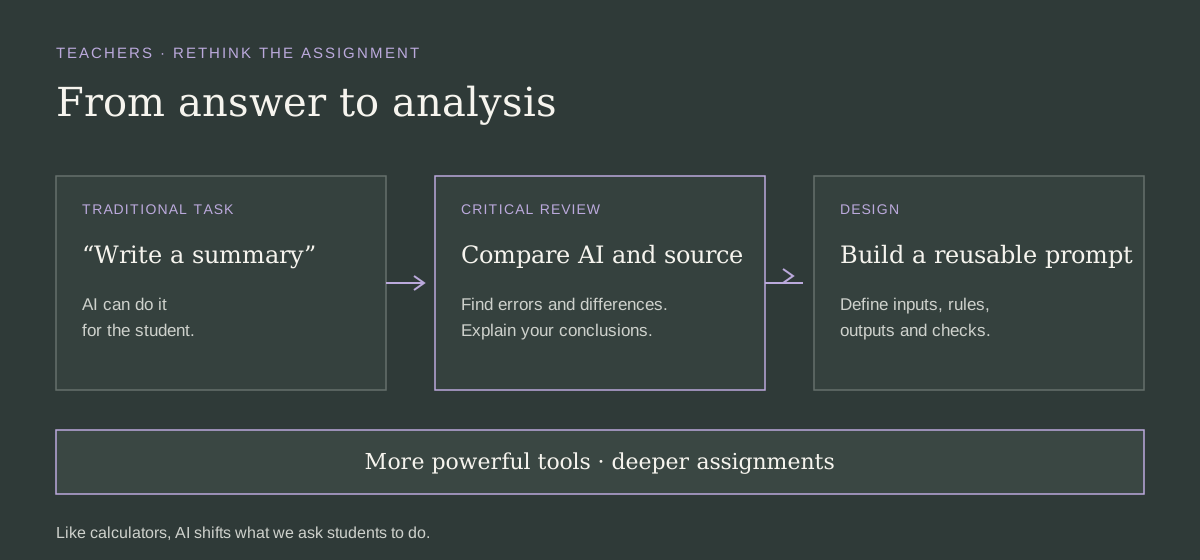
If you ask students to translate a passage, write a summary or read a chapter, some will predictably ask an AI agent to do it and hand in GPT’s output as it is. That is no surprise, and pretending it does not happen will not solve it. It is a reason to rethink the assignment.
“Translate this”, “write me a summary”, “read this chapter”: AI can complete those tasks in seconds. If the final product is the only thing we assess, it becomes difficult to distinguish a student’s work from an agent’s. Instead, ask students to show their process: what they asked, what they checked, what they changed and why.
More powerful tools also make it possible to ask students to do more complex work. Instead of “summarise this”, ask them to use AI to create a composition that engages with a text, analyse the result in detail and explain where they disagree with it. If a student does not feel ready to read the whole text, they can use an AI summary as support—but they must compare it with the source. A model can add details that are not there, and recognising that is part of the task.
For example, after reading a passage, a class could ask AI to write a short composition inspired by it. The assignment does not end with the composition: each student notes which elements genuinely come from the text, which ones the model added, and which stylistic choices work or do not. Another exercise could compare the AI’s summary with a student’s own summary and discuss which one preserves the argument better and where the model introduced a detail absent from the source.
More broadly, assignments can be designed to gain something from AI: rather than asking only for a result, ask students to assess, discuss, verify and improve it.
In computing, for example, a suitable pre-AI assignment might have been: “write a program that solves this problem”. Now students can also be asked to design a reusable prompt that tackles the problem systematically: it accepts data in a known format, returns a usable output and perhaps feeds another step in a workflow. This is not just writing a request to a chatbot; it is designing a repeatable, checkable process.
A concrete exercise could start with a small set of reports in JSON and ask students to design a prompt that assigns each report to one of several given categories, returns a category and reason, and flags ambiguous cases instead of guessing. Students test the prompt on sample data, check whether the output is valid and record its errors. They then improve it and explain how the result could become input for another step, such as a report or a review queue.
Assignments that used to be challenging can become trivial with AI, much as some calculations did when calculators arrived. Calculators were initially banned because people worried students would stop learning multiplication. Today we can ask whether we want merely to endure AI or learn to use it—and set assignments that account for what the tool can do.
The calculator did not remove the value of mathematics; it shifted attention from repetitive calculations to problems and reasoning. AI brings a different change because it produces text and explanations too, but the teaching question is similar: what skills should students develop now that the tool can do part of the work? A blanket ban or repeating the same exercises will not teach them to use it. We can raise the level of our questions and assess the judgement students apply.
Teachers can also use a prompt to design an activity where AI becomes part of critical work without replacing learning:
Prompt for teachers
Design an assignment for a [grade level and subject] class on [topic], to be completed in [time]. Students may use AI, but they must compare its output with [assigned text or source], verify at least one claim and explain one point they agree or disagree with. Propose the instructions, work stages and assessment criteria, distinguishing understanding of the content, quality of analysis and thoughtful use of AI. Do not complete the assignment for the students.
The assignment prompt can ask for the work stages and a rubric as well:
<task role="assignment-design">
  <context>
    <class>[School level, grade and class profile]</class>
    <subject>[Subject and topic]</subject>
    <time>[Available time and work format]</time>
    <source>[Assigned text, document or learning material]</source>
    <permitted-tools>[AI tools allowed or school constraints]</permitted-tools>
  </context>
  <goal>
    Design an assignment more substantial than a basic translation
    or automated summary. Students may use AI for support, but must
    understand the content, verify the output and show their reasoning.
  </goal>
  <assignment>
    Write clear instructions asking students to compare an AI answer
    with the source, check at least one claim, identify an error,
    limitation or disagreement, and justify their conclusions.
    When appropriate to the subject, include a composition inspired
    by the source and ask students to analyse what AI reused, changed
    or added.
  </assignment>
  <evidence-of-work>
    Specify what students submit: final work, prompt used, verification
    steps, comparison with the source, corrections and a short reflection
    on what they learned.
  </evidence-of-work>
  <assessment>
    Propose separate criteria for understanding, use of evidence,
    quality of analysis, reasoned agreement or disagreement,
    and thoughtful use of the tool. Explain what distinguishes
    a basic response from a well-supported one.
  </assessment>
  <constraints>
    Do not treat AI output as correct by default or design an assignment
    that can be completed by copying its answer.
    Do not ask students to enter personal information.
    Do not do the work on their behalf.
    Do not assume school rules I have not provided.
    Flag what the teacher must adapt and suggest a check for whether
    the assignment measures the intended learning.
  </constraints>
  <response-format>
    Return: learning goals; student instructions; work stages;
    materials; assessment criteria; possible AI errors to discuss;
    and required adaptations.
  </response-format>
</task>
Parents: let’s not stay on the sidelines
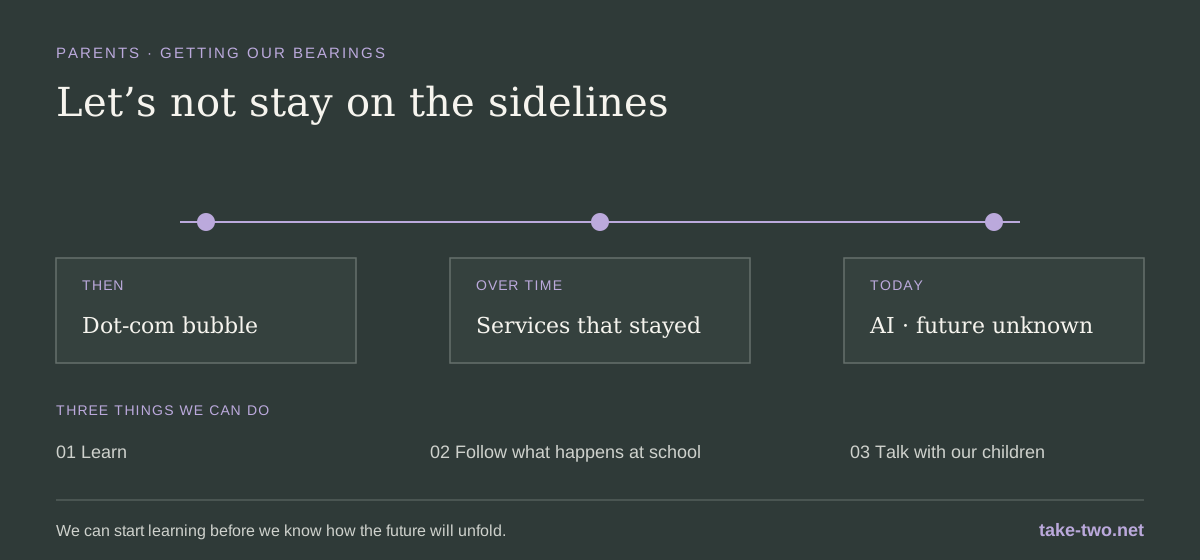
Many parents today are meeting AI in much the same way their own parents once encountered the internet. Some are curious and try to use it; others would rather ignore it, assuming it is a passing fad. That reaction is understandable: when something new arrives, it is hard to know how much it will change daily life.
We have seen a similar divide in our own families. When the internet arrived, some parents treated it as a fad or as something too complicated to use. Many of us now have to decide whether to stay curious or dismiss AI before trying it. We do not need to chase every novelty; we do need to avoid closing our eyes to a change young people are already encountering.
The dot-com bubble burst and many companies disappeared. But the internet did not disappear: major names such as Google and Amazon remained, and Facebook emerged later. A bubble can end without erasing the technology around it; some services and companies continue to grow and influence society. We do not yet know which AI companies will last or which uses will matter most.
What we can do now is stop pretending the technology does not exist. A little learning is useful for parents too. We can pay attention to how AI is discussed at school, how it is entering teaching and how young people use it in their homework. Let’s not leave them as uninformed spectators, and let’s not remain uninformed spectators ourselves.
That also means talking with the school: which tools are allowed? For which activities can students use AI? What should they disclose? How are answers checked? At home, we can ask young people to show us an example of how they used the tool and what they had to verify. The aim is not to monitor every request, but to understand what they are learning and help them develop independence.
Generational change is inevitable. Sooner or later, our children will think we do not understand something that feels ordinary to them. But we can try not to repeat the scene of grandparents sticking with a big-button Brondi phone because WhatsApp seems too complicated. We do not need to know everything about AI already. We can be curious, learn and talk with young people while learning alongside them.
Parents who want to get oriented can ask AI for a basic explanation without treating it as an infallible source:
Prompt for parents
Explain in plain English what a generative AI assistant can do and what it cannot guarantee. Help me understand what to ask my child and their school about using it for schoolwork. Distinguish facts from uncertainties, do not assume the school’s rules, and tell me which information I should verify with a person or a reliable source.
A more targeted version can give the assistant a role and ask it to distinguish what it knows from what needs checking:
<task role="orientation-for-parents">
  <context>
    I am a parent trying to understand how my child uses AI
    to study and complete school assignments.
    I may not know which tools the school permits or what its rules are.
  </context>
  <goal>
    Explain in plain English what generative assistants do,
    how they produce answers, and why they can make mistakes,
    invent details or present a guess as a fact.
  </goal>
  <questions-for-school>
    Suggest respectful questions for my child and their teachers:
    which tools are allowed, for which assignments, what information
    may be entered, when AI use should be disclosed, and how claims
    in the output should be checked.
  </questions-for-school>
  <conversation-at-home>
    Suggest a calm way to ask my child to show me one example:
    what they asked the tool, what they checked and which parts
    of the work they completed themselves. Keep the tone curious,
    not accusatory.
  </conversation-at-home>
  <limits>
    Do not assume the school's rules.
    Distinguish general facts from details I need to verify.
    Do not present AI as always reliable or always useless.
    Do not make confident predictions about which companies or tools
    will last. If an answer depends on current or local information,
    tell me what to check with the school or a reliable source.
  </limits>
  <response>
    Organise the answer into three parts: a basic explanation;
    questions for the school and my child; and three practical steps
    I can take to learn more and talk with my child without replacing
    teachers or other qualified people.
  </response>
</task>