Activating an AI assistant is easy. Helping people use it well, for suitable tasks and with the right checks, takes more work: choosing the tools, setting clear rules and helping people fit them into their jobs.
Training is not a box to tick before launch. It is an ongoing process that follows the tools and the work as they change. A model is updated, a new feature appears or a trial reveals a limitation: each change can affect how people should work. Companies need regular opportunities to learn, ask questions and review their practices.
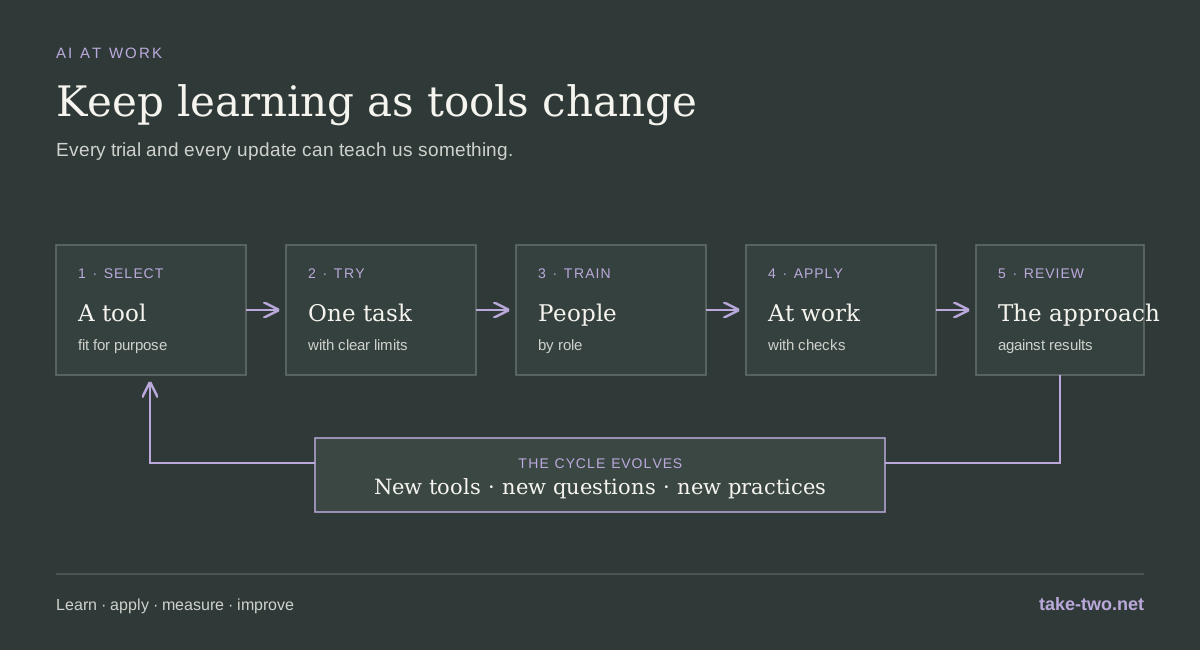
Decide what to introduce first
The choice should not start with an available licence or a persuasive demonstration. Identify specific tasks, understand what data they involve and decide what good work looks like. A bounded trial helps assess quality, time, corrections and risks before a tool is rolled out more widely.
Meanwhile, set simple rules: which tools are approved, what information people may share, when a person must check the result and whom to ask when something is unclear. Make the rules easy to find and update them as the tools or use cases change. A list of prohibitions without practical guidance leaves people to make everyday decisions on their own.
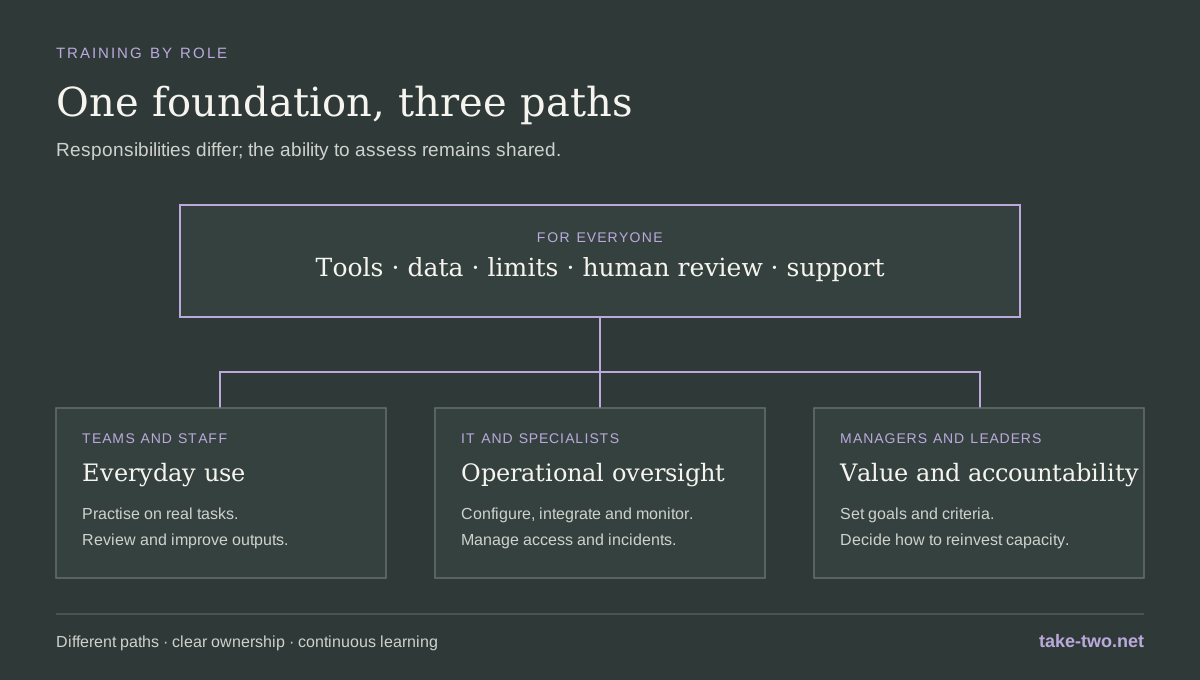
A shared foundation, different learning paths
Everyone needs a shared foundation: what a tool can and cannot do, how to handle data, how to spot a result that needs checking and how to report a problem. From there, training should follow people’s responsibilities and tasks.
People using AI in their day-to-day work need practice with tasks that fit their roles. They can learn to provide context, make clear requests, assess responses and use an assistant without handing over decisions that remain theirs. Examples should resemble real work, using authorised or sample data.
People who configure tools or workflows need to learn more about permissions, integrations, information handling, monitoring and incident procedures. A prototype that works for its author is not yet a service ready for a whole team: someone must be able to maintain it, assess its errors and decide when to stop it.
Managers and team leads need an additional path. They should know what results to expect, how to assess costs and benefits, and where human expertise is still needed. A convincing response is not proof that it is correct; a task that takes less time does not automatically save money if that time is immediately filled with more work.
An initial course, then role-specific development
A first course can begin with a session for everyone: which tools are approved and what data may be entered; how to give a request context and an objective; how to check a response before using it; how to recognise an error and where to report it. After a short demonstration, each person can try a familiar task with sample data and compare the AI’s output with an expected result.
Training can then move on to different exercises. Teams can work on drafts, summaries or classifications that fit their jobs, learning to correct and document the results. IT and specialists can try limited configurations and workflows, focusing on access, data, testing, monitoring and error handling. Managers can assess a use case, set quality and cost measures, and discuss how to use the time freed up without assuming that every task is ready for automation.
Questions from day-to-day use can later become material for updated examples and guidance. Teams can hold short peer discussions, explore a new tool or feature, and repeat exercises when a process changes. The initial course creates a shared vocabulary; practice and updates keep training close to the work people actually do.
Who keeps the learning path up to date?
In a medium-sized or large company, a research and development group, or an equivalent function, can track models, test updates and assess new use cases. Its job is not to adopt every new feature. It is to run experiments against clear criteria, involve the relevant teams and turn successful trials into guidance, tools and reusable training.
The group should work with IT, security, process owners and the people doing the work. They know about exceptions and checks that a technical trial may miss. Any decision to expand a tool should also account for support, access, service continuity and operational responsibility.
In a small organisation, an IT team can track updates and coordinate trials, perhaps with support from an experienced colleague or partner. But IT should not become the sole owner of training: team leads can help choose relevant exercises and make time for people to practise. The size of the company changes how it organises the work, not the need for an owner and a process.
Managers: invest the time gained
Training for managers should start with practical questions. What problem are we trying to solve? Which measures will show whether the tool helps? Who checks the result and steps in when it is wrong? What data and skills are needed to maintain the process? How will we use the time we free up?
That last question shapes the project. If AI reduces repetitive work, a company could give customers better support, improve a service, clear a backlog or make time for new skills. These are opportunities to plan for, not automatic effects of the technology.
The idea of replacing human operators with agents also needs to be assessed as a process decision, not a guaranteed saving. An agent may require configuration, checks, exception handling and human intervention. Before assigning it important tasks, measure quality, total costs and the consequences of errors. Supervision does not disappear just because work has been delegated to a system.
It can be forward-looking to reinvest the resources freed up: train people, improve processes and try new services. As the company gains experience, it will be better placed to decide where to automate and where human contribution remains essential.
A cycle that keeps going
A good introduction includes regular reviews: listen to users, check outcomes, update examples and revisit instructions. When the model, its features or the process changes, assess whether training needs to be repeated or adapted. If a trial brings no value, stop and learn from the result.
AI training has no end date because the tools keep evolving. The goal is not to make everyone use everything. It is to help each person decide when AI is useful, how to check it and when to rely on their own judgement or ask for support. That is how a technical development can become an organisational capability.